Research To Road: How A Single Paragraph Gets Written (Part One).
"月日は百代の過客にして、行かふ年も又旅人也。"
“Days and months are travelers of eternity…the voyage itself is home.”
- Matsuo Basho, The Narrow Road to the Deep North,1689
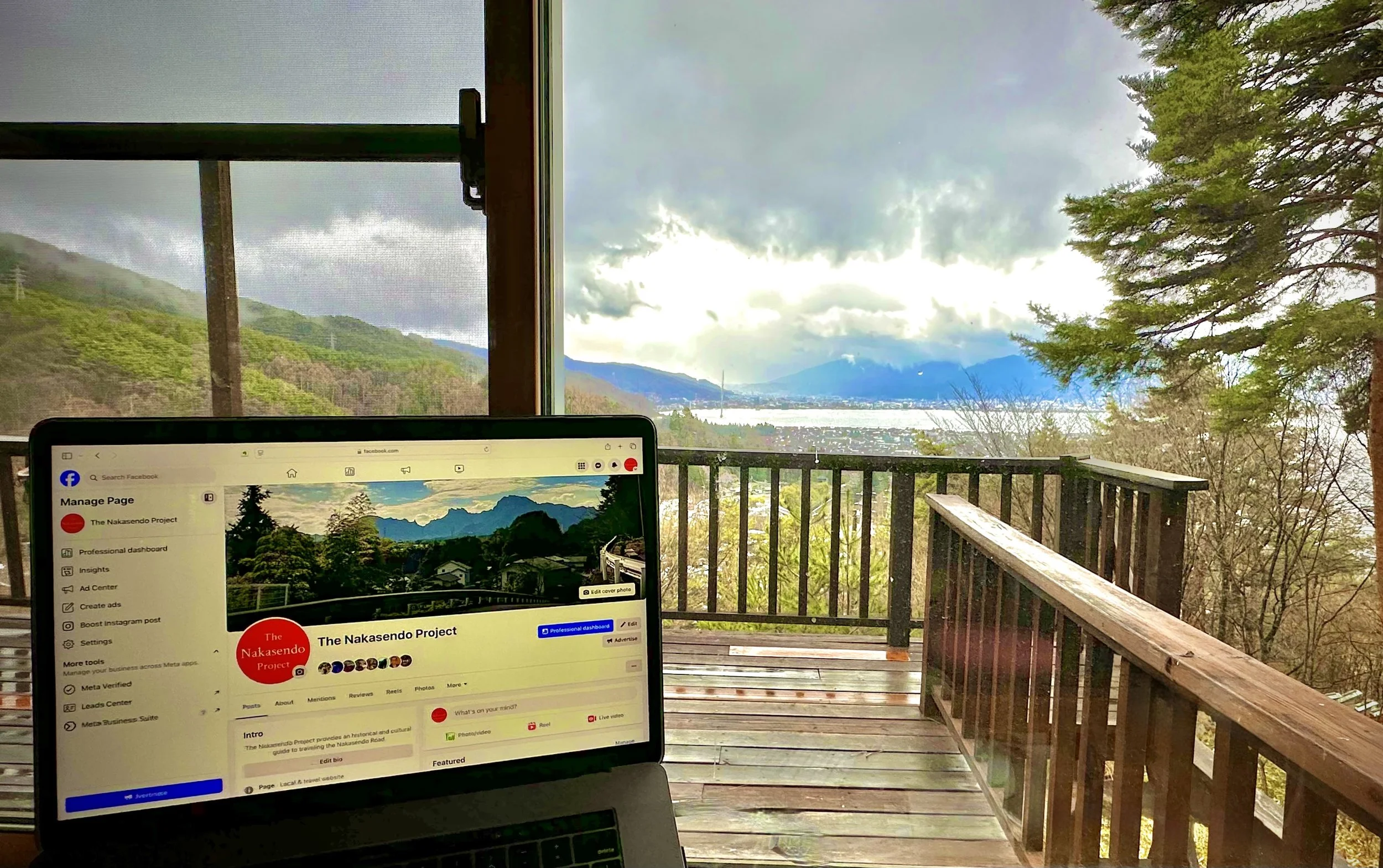
The authors’ temporary office in Shimosuwa, Nagano Prefecture
Sequestered at home in early 2020, we watched helplessly as the world slowly shut down.
The string of refunds and confirmed cancellations trickling in from hotels and inns in Japan was a minor consolation to our disappointment at having to cancel our exploration of the Nakasendō in the spring. Japan was not new to us. Having lived there in the 1980s, we had studied the country in university and graduate school, and returned regularly over three decades for work, travel and to keep up with friends. Looking back now, though, it’s astonishing to realize how unprepared we were for the journey and how little we knew about the road and its history. We were determined to put our enforced isolation to good use to correct that, but we didn’t realize at the time that we were about to embark on a completely different journey than we’d planned. A journey of wading through layers and layers of research, learning the perils of taking our assumptions as fact, discovering the joys of literally reaching out and touching history, and uncovering a Japan we thought we knew.
Initial Research
With time stretched out before us and no sign of when the global quarantine would end, we got to work. The first task was reading every modern-day Nakasendō walking journal we could get our hands on. Western accounts, we quickly discovered, were scarce. Those that existed mostly focused only on the Kiso Valley (a stretch of road that in total represented just over 10% of the total journey) and usually on the two heavily hyped tourist towns of Tsumago and Magome. They tended to be superficial and high-level with little historical or contextual content and leaned hard on the trope of the Nakasendō as the “Trail of the Samurai.” Others sold walking tours with the same theme and, again, almost entirely focused on the Kiso Valley.
Japanese guides, which were more plentiful, most often than not covered the entire road from Nihonbashi to Kyoto, but frequently focused on minutiae, heavily dependent on the writer’s interests (daily meals, descriptions of inns, etc.). Many focused on significant religious temples, shrines and monuments, possessing an assumption of a shared understanding of Japanese history, famous places and culture with cryptic references that would be confusing or flat-out indecipherable to a Western audience. In fairness, as we would discover later, not much different from the diaries of their 400-year-old predecessors.
We divided the work: one took on documenting the physical points on the road; the other researched the historical context. When a roadside point of interest made little sense, or we felt there might be a bit more to the story, the other researched the background, and vice versa. Sometimes, a deeper dive turned up nothing. But very often it turned up fascinating stories that added color to the picture of life on the road. This rapid evolution of expertise on both sides would become a core strength for us as a team but also serve as essential cross-checks for accuracy and storytelling as we moved forward.
Next came the dogged accumulation of sources focusing on broader history and the major historical periods that applied to Japan’s pre-modern highways: the Sengoku period (1467-1600), the Edo, or Tokugawa period (1600-1868), and the Meiji period (1868-1912). Helpful in establishing scope, constraints, and general factors that affected road travel, heavily focused on politics, governance, major battles, but less useful in understanding the human experience of the journey.
Despite the strengths and weaknesses of the sources, we saw the outline of a complex and fascinating history that played a much larger role in the formulation of modern Japan than we had known. This history wasn’t confined to dusty libraries or museums; it was out in the open, waiting for modern-day travelers to discover it. Together, both journals and broad history provided clues, general context, and threads to pull, and there was far more to go.
Specialized Sources
Western academic research into daily life and travel culture in pre-modern Japan is a surprisingly new field. It languished into the 1970s when academics were more focused on interpreting events leading up to the Second World War, postwar recovery and the resulting “economic miracle”. Most Japanese historians remained focused on the modernization of Japan during the Meiji period and pre-war years. For many, the Edo period was a time of feudalism, backwardness and immorality and deserved less attention than the foundations of Japan’s rising prominence in the global economy.
By the 1980s, however, specialists in the history of food, travel, culture, art, and the elements of rural life produced research beyond political and institutional history. The Japanese themselves, many disillusioned by the dizzying pace of economic growth, looked back to the Edo period with nostalgia as a simpler time, where natural beauty, culture, and traditional values contrasted with the pressures of modern Japanese life. Heroic figures of the period reemerged as popular cultural icons in anime, TV, and movies, celebrated for their bravery, self-sacrifice, and honor. “Taiga” historically based dramas produced by NHK peaked in viewership in the 1980s, focusing predominantly on the period between the mid-15th through the 19th centuries. Academics continued the trend, consuming old records, artifacts, and literature that emerged from dusty attics and rural warehouses to be studied in a new light.
We dove into the work of both Western and Japanese scholars who made great strides in this nascent area of study. Our library grew with Constantine Nomikos Vaporis’s excellent work on Japan’s pre-modern highways and the reality of samurai daily life, Anne Walthall’s studies on peasant protests and uprisings, Amy Stanley and Laura Nenzi’s extensive work on women’s lives during the Edo period and Shiba Keiko’s essential collection of Edo era women’s travel diaries, along with so many others too many to name here. A surprising part of our collection was the travel diaries and writing of western travelers who flooded into Japan after its opening to the world in the mid-19th century. They too became part of the road’s story and provided some unique cultural perspectives.
Our core reference mapping the road and points of interest was the very best guidebook we could find, “This Way to the 69 Nakasendō Stations” (中山道69次資料へ) by the most eminent modern historian of the Nakasendō, Kishimoto Yutaka. A two-volume detailed walking guide written for a Japanese audience, it allowed us to see the road as the Japanese saw it while providing a treasure trove of hints and leads to stories that we believed would resonate with a larger audience.
Preparing For the Field
With our archive established (and steadily growing…), it was time to apply it to the physical geography of the road itself. We started by organizing our research by region and prefecture and then by geography (cities, mountains, the Kantō Plain, Lake Biwa, etc.). Next came the historical threads and themes we would use to tie them together and connect to a Western audience. Above all else, though, we kept our focus on the stories of travelers, of people who walked the road, lived and worked on it, gave it life and created legacies that have carried through to the present day.
Finally, in 2023, Japan cautiously opened its doors to the world. The library was full; notes were written; checklists were completed; initial maps were drawn. We were ready to go.
(To be continued in Pt. 2…)